

BISP 8171 Missing Payments
The BISP 8171 program supports millions of low-income families across Pakistan. For many households, these payments are essential for covering basic needs. When payments fail to appear, beneficiaries face worry and uncertainty. Understanding the causes behind missing payments helps avoid confusion and ensures smoother access to financial support.
Missing payments usually occur due to errors in records, verification delays, or technical issues. Even though BISP has improved its system through online portals, mobile wallets, and bank transfers, problems can still arise. Beneficiaries must stay updated and verify their details to avoid interruptions in receiving assistance. Regular checks help ensure timely payments and prevent unnecessary delays.
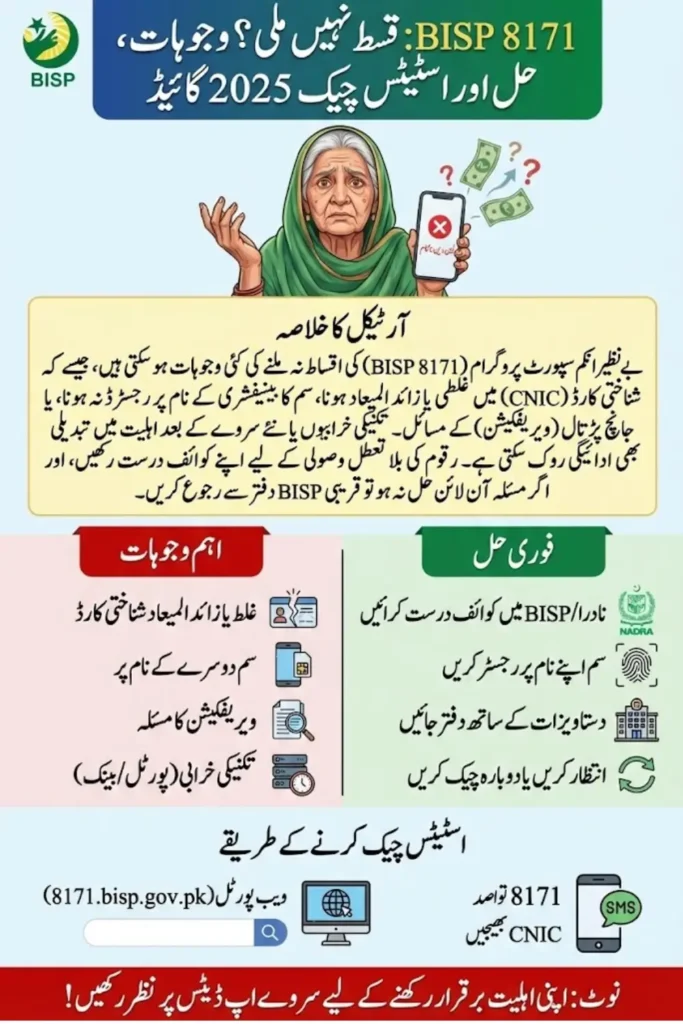
Common Reasons Why BISP 8171 Payments Do Not Show
There are several common causes behind missing BISP payments. Identifying these reasons helps beneficiaries take action quickly. Many issues stem from incorrect personal details or delays within the verification process. Others relate to system errors or banking delays that affect payment visibility.
Some reasons include incorrect CNIC details, SIM registration issues, or delays at payment centers. Portal errors also cause temporary disturbances. Beneficiaries should verify information regularly and follow official procedures to reduce payment issues.
- Incorrect or expired CNIC
- Verification mismatch
- Payment center backlog
- Technical issues on 8171 portal
- SIM not registered in beneficiary’s name
Incorrect CNIC Details or Expired CNIC
Incorrect CNIC information is one of the most common reasons payments do not show. If the CNIC number does not match BISP records, payments cannot be processed. Even small mistakes can block the transfer. Beneficiaries must ensure that all details match NADRA records exactly.
BISP 8171: Guide to Eligibility, Registration, Payments, and Benefits
An expired CNIC can also stop payment processing. BISP requires valid identification for verification. If a CNIC has expired, beneficiaries must renew it immediately. Updated information must also be shared with BISP to restart payments.
- Renew expired CNIC
- Update incorrect CNIC details with BISP
Payments Blocked Due to Verification Issues
BISP conducts routine verification to confirm the eligibility of households. If any mismatch appears during verification, payments may be blocked. This can happen when documents are outdated, missing, or incorrect. Beneficiaries must complete verification on time to avoid delays.
In many cases, verification problems require an in-person visit to the nearest BISP office. Staff review documents and update records to restore payments. Completing verification ensures smooth delivery of future installments.
- Provide correct documents
- Visit BISP office for verification corrections
Eligibility Changes After Re-Survey
BISP regularly updates its records through new NSER surveys. These surveys check whether families still qualify under the updated criteria. If a household no longer meets the poverty score requirement, payments may stop. Beneficiaries must stay aware of survey updates and eligibility changes.
Re-surveys help ensure that assistance reaches deserving families. If eligibility changes or income increases, payments may be withheld. Beneficiaries should check the latest BISP announcements to understand their status.
Table: Common Eligibility Issues After Re-Survey
| Issue | Outcome |
|---|---|
| Income increase | Payments stopped |
| Missing survey update | Eligibility pending |
| Mismatched records | Verification required |
Technical Issues on the 8171 Portal
Sometimes missing payments are caused by temporary technical problems. The 8171 portal may experience system load or maintenance, delaying the display of payments. Beneficiaries may mistake this delay for a payment issue. Waiting for updates often resolves the problem.
Banking systems also face delays, especially during high traffic. Payment centers may experience slow processing, causing funds to appear late in accounts. Checking with the bank or payment center can confirm whether funds have been received.
- Check portal during non-peak hours
- Call bank or payment center for confirmation
SIM Not Registered in Beneficiary’s Name
Many BISP payments are transferred through mobile wallets. These wallets require the SIM to be registered under the beneficiary’s name. If the SIM belongs to someone else, payments may fail or be delayed. This rule ensures secure transfers and prevents fraud.
Beneficiaries using another person’s SIM should update the registration immediately. Mobile service providers offer easy ways to transfer SIM ownership. Once updated, payments usually resume without further issues.
- Register SIM under your name
- Use only one mobile number for BISP services
How to Check Your BISP 8171 Payment Status Correctly
Beneficiaries should follow the official method to check payment status. The most reliable option is the BISP portal, where users enter their CNIC number to view current details. Ensuring accurate entry helps avoid false errors.
SMS checking is another simple method. Sending the CNIC number to 8171 shows eligibility and payment updates. Using a registered SIM is important to receive correct information.
- Enter CNIC at official portal
- Send CNIC to 8171 from registered SIM
- Check mobile wallet or bank account
8171 Tracking Portal 2025: Check Your CNIC for 13,500 Payment Status
How to Resolve a Missing BISP Payment
If a payment does not appear, several steps can help fix the issue. First, beneficiaries must confirm their CNIC information and SIM registration. Updating expired or incorrect details often resolves the problem quickly.
If the issue continues, the beneficiary should review eligibility and verification status. Visiting the nearest BISP office helps resolve disputes and update records. Keeping documents and previous payment messages helps speed up the process.
- Correct CNIC details
- Check eligibility status
- Report issue at BISP office
When to Visit the Nearest BISP Office
Some issues require an in-person visit to the BISP office. These include verification errors, CNIC mismatches, and unresolved eligibility disputes. Staff can access the full record and provide solutions.
Beneficiaries should visit the office only when online and SMS methods do not solve the problem. Taking original documents helps ensure quick resolution.
- Visit if payment missing after all checks
- Go for CNIC corrections and verification
- Report unresolved eligibility issues
Final Tips to Avoid Future BISP Payment Issues
Beneficiaries can prevent most payment problems with a few simple steps. Keeping CNIC and contact information updated reduces delays. Using a registered SIM ensures smooth message delivery and wallet transfers.
Staying informed about BISP updates and survey schedules helps avoid sudden eligibility issues. Keeping payment receipts and notifications provides a clear record for future reference.
- Keep CNIC updated
- Use registered mobile number
- Track survey updates
- Maintain payment records
FAQs
Why is my BISP 8171 payment not showing even though I am eligible?
It may be due to incorrect CNIC details, SIM issues, or pending verification. Updating records usually fixes the problem.
How can I check my BISP 8171 payment status?
You can check it through the BISP portal using your CNIC or by sending your CNIC to 8171 from a registered mobile number.
What should I do if my CNIC is expired?
Renew your CNIC through NADRA and update the information with BISP to restore payment processing.
Can technical issues delay my payment?
Yes, both portal errors and banking delays can cause temporary payment issues, but these are usually resolved automatically.
When should I visit the BISP office?
Visit when online checks fail, or if verification, eligibility, or CNIC mismatches require in-person support.
Benazir Kafalat Program 2025: Latest Update on Document Verification for 13,500 Beneficiaries